
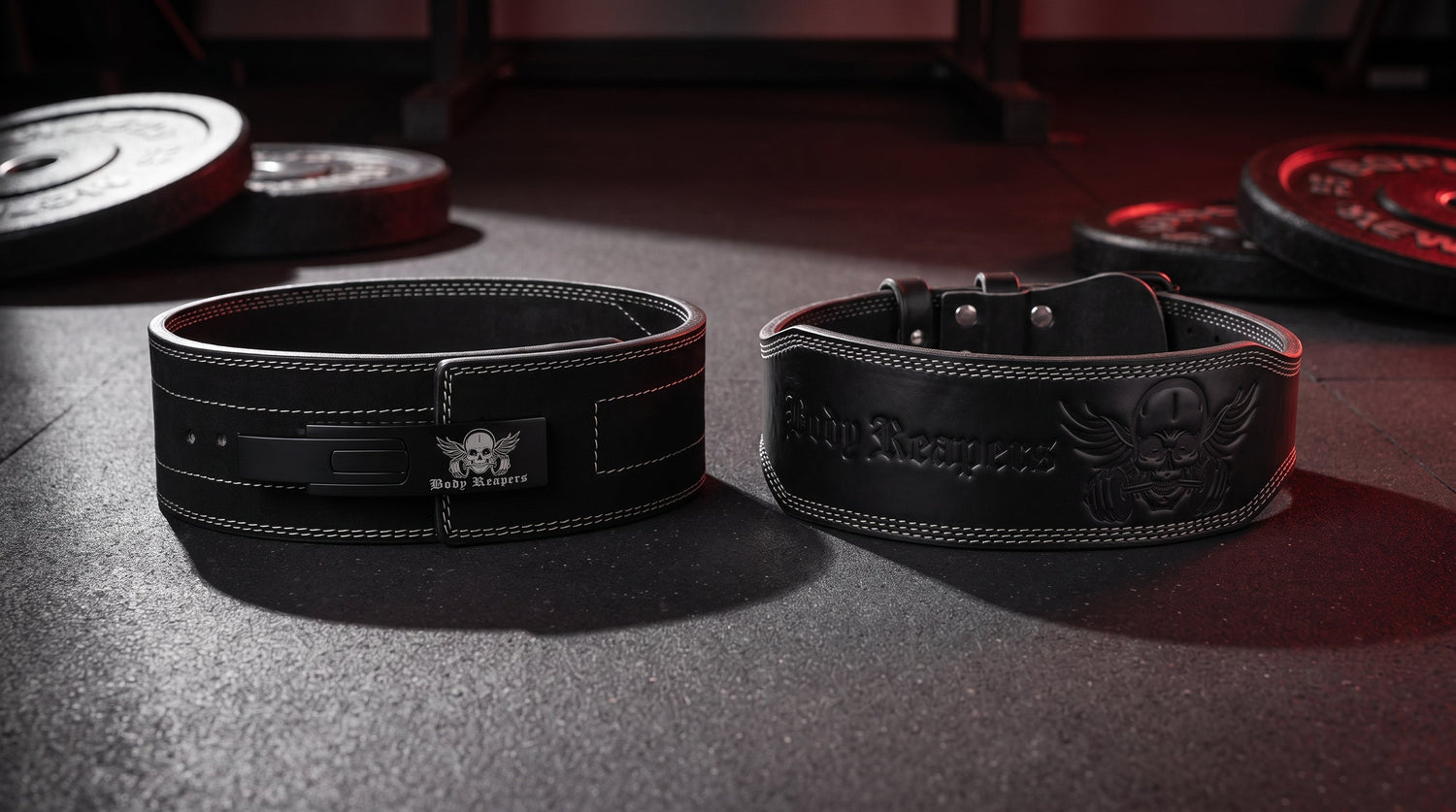
You've decided you need a weightlifting belt. That part was the easy call. Now you're staring at two options, lever or prong, and realizing the internet gives you a different answer depending on which forum you landed on last.
The difference between a lever belt and a prong belt is not cosmetic. It affects how consistently your belt supports your spine, how quickly you can transition between movements, and whether you're building a training career that lasts a decade or a pattern of preventable injury.
At Body Reapers, we build lifting accessories from a clinical foundation. Our founder is an orthopedic Physician Assistant who spent years treating lifters with spinal injuries, then rebuilt his own after a herniated disc in a falling-elevator accident. When we say we have a strong opinion about belt mechanisms, it's because we've seen what happens when that decision goes wrong.
What Is a Lever Belt?
A lever belt uses a metal latch mechanism: a hinged lever that clicks into a fixed position. You fasten it to your desired tightness once, and from that point on the belt snaps on and off in two to three seconds flat. No threading, no alignment, no guesswork. Our 10MM Lever Belt is built on exactly this mechanism.
The engineering principle is simple but meaningful: the tension is identical every single time. You set it once. The mechanism replicates it. Your lumbar spine receives the same intra-abdominal pressure support on your first warm-up set as it does on the last rep of your heaviest working set.

What Is a Prong Belt?
A prong belt uses a traditional buckle-and-hole system, identical in principle to any leather belt you've worn. You thread the prong through a hole, secure it, and you're set. Most prong belts come with one or two prongs. Our 7mm Double Prong Leather Belt is the two-prong version of this design.
The adjustment is manual and variable. Every session, you're threading it through whichever hole feels right at that moment. On a heavy deadlift day you might pull it a notch tighter. After a big pre-workout meal you might need to back off. That flexibility is real. So is the variability it introduces.
The Real Differences: What Actually Matters
Tension Consistency: The Clinical Argument
This is where the case for lever belts is strongest, and it starts with understanding why a belt protects you.
Intra-abdominal pressure (IAP) is the mechanism by which a weightlifting belt works. When you brace your core against a tight belt, you create a pressurized cylinder around your lumbar spine. That pressure reduces compressive load on your vertebral discs and significantly improves your capacity to transfer force from your lower body through your trunk without shear loading at L4-L5 and L5-S1, the two most common injury sites in heavy lifters.
For IAP to work at the level it's capable of, the belt must be at consistent tension every time. A loose belt creates insufficient IAP. A belt that's tighter some sessions and looser others means variable spinal support, and variable support means your discs are absorbing inconsistent, unpredictable load across hundreds of training sessions per year.
With a prong belt, you rely on manual feel to recreate the same tension every session. Most lifters cannot do that reliably, especially when fatigued, rushing between sets, or deep into a heavy training block when coordination and attention are taxed.
With a lever belt, you set the position once and the mechanism handles replication automatically. You don't have to think about it.
For lifters who train heavy compound movements three to five days per week, this difference compounds. The prong belt introduces small tension variability on every set. The lever belt eliminates it.

Speed and Transition Time
In powerlifting meets, and in any training session involving supersets, circuit work, or conjugate-style programming, transition time matters.
A lever belt is fully on or fully off in two to three seconds. Pull the tab, done. Snap it shut, done.
A prong belt requires threading, alignment, and enough manual force to push the prong through stiff leather at your target tightness. Under heavy load, with hands that are chalked and fatigued, this realistically takes 20 to 40 seconds per transition. In a competition queue with a tight clock, that's a real problem. In training, it's a friction point that subtly discourages consistent belt use.
Lifters who find the belt a hassle are more likely to skip it on accessory movements or moderate-intensity sets, and those are often the sessions where a lumbar strain quietly begins.
Adjustability Between Training Phases
Prong belts have a legitimate advantage here, and it's worth being honest about it.
If your body composition changes significantly (a serious bulking phase, an aggressive weight cut, a recovery block where training volume drops and your midsection changes) a prong belt adapts in seconds. Move a hole. Done.
A lever belt requires a small manual adjustment (a coin or flathead screwdriver) to reposition the lever bracket. It takes 30 seconds when you know how, but it is a discrete step that some lifters find inconvenient mid-cycle.
For lifters whose body weight fluctuates more than 10 to 15 pounds across training phases, this matters. For lifters who maintain stable body composition across the year, it almost never comes up.
Competition Legality
If you compete or plan to compete in powerlifting, verify your federation's equipment list before purchasing.
- IPF (International Powerlifting Federation): Both lever and prong belts are permitted, but only from brands on the approved equipment list. Verify before purchasing if you compete internationally.
- USPA, USAPL, CPU, and most domestic federations: Both belt types are legal with no brand restrictions, within standard sizing limits (maximum 10cm width; 13mm maximum thickness for single-ply).
The Body Reapers 10MM Lever Belt meets IPF competition specifications: 10mm thickness, single-ply construction, 4-inch width, built for competition-legal use from day one.
When a Prong Belt Is the Better Choice
Be honest with yourself. A prong belt genuinely makes sense if:
- You're new to belt training. While you're still learning to brace correctly and calibrating what tight feels like, a prong belt lets you experiment with different tension levels without committing to a fixed position. Once you know your ideal tightness, you can set a lever to match it.
- Your weight fluctuates significantly. If you're actively bulking or cutting 20-plus pounds, hole-by-hole adjustability has real practical value.
- Budget is the deciding constraint. Equivalent-quality prong belts are generally available at a lower price point than lever belts.
There is no clinical argument for a prong belt over a lever belt when all other variables are equal. The lever mechanism is strictly superior for support consistency. But all other variables are not always equal, and the above scenarios are where a prong belt earns its place.
If any of those three describe you, the Body Reapers 7mm Double Prong Leather Belt is the belt we built for that role: genuine leather, double-prong security, and a lighter 7mm profile that breaks in faster and adjusts hole-by-hole as your body changes.
When a Lever Belt Is the Right Tool
A lever belt is the correct choice if:
- You train heavy compound lifts (squat, deadlift, overhead press) on a consistent weekly schedule and treat spinal protection as a non-negotiable.
- You compete or plan to compete in any powerlifting or strength-sport federation.
- Your body weight is stable within a 10 to 15 pound range across the training year.
- You want to remove one variable from your training: consistent support, identical every session, with no manual error.
The Body Reapers 10MM Lever Belt was designed for exactly this purpose: competition-legal, clinically-informed lumbar support for lifters who've stopped treating their spine as an afterthought.
What to Look for in Any Weightlifting Belt
Whichever mechanism you choose, these specifications determine how well the belt actually does its job:
- Thickness: 10mm for all-purpose lifting. 13mm for maximum powerlifting support: stiffer, requires 2 to 4 weeks of break-in, and provides a higher IAP ceiling once broken in.
- Width: 4 inches at the back, the legal maximum for most federations and the optimal contact width for lumbar spine coverage.
- Material: Single-ply leather. Not suede, not nylon, not neoprene for heavy compound lifts. Leather maintains structural rigidity under repeated load. Neoprene compresses and degrades.
- Stitching: Double or triple-stitched perimeter. Stitching is the most common failure point under maximal load, particularly at the buckle attachment.
- Break-in period: Expect 4 to 8 training sessions before a stiff leather belt conforms to your torso. A belt that feels immediately comfortable is usually not stiff enough to generate optimal IAP.
Explore the full Body Reapers weightlifting belt range to compare thickness and sizing options.
The Bottom Line
The lever versus prong debate is not about brand preference or tradition. It's about what the mechanism does to your spinal support across thousands of training sessions.
Lever belts win on tension consistency, transition speed, and long-term injury prevention. Prong belts win on adjustability and accessibility for lifters who are still dialing in their setup.
If you train seriously, maintain stable body composition, and want every heavy set backed by the same mechanical support: the lever is the right choice. Not because it looks more professional. Because consistent IAP is measurable, clinically meaningful, and something you cannot reliably replicate manually on every session for every training year.
Your spine doesn't get a day off from load. Your belt shouldn't get a day off from doing its job.
Still working through the belt decision? If you're not sure you need a belt yet, start with when to use a belt for deadlifts, which covers the load thresholds where a belt starts earning its place. If you've chosen your mechanism and are now weighing dimensions, our 3-inch vs 4-inch belt guide explains how width changes the brace. And if lower back pain is what brought you to belts in the first place, the orthopedic breakdown of deadlift lower back pain explains the three mechanical causes and when a belt is the right tool for each.

Made your choice? Both belts are built on the same clinical foundation:
Shop the Body Reapers 10MM Lever Belt → for consistent tension, competition-legal, built for heavy weekly training.
Shop the Body Reapers 7mm Double Prong Leather Belt → for adjustable hole-by-hole fit and faster break-in, the right call while you're dialing in your setup.
Or compare the full Body Reapers weightlifting belt range side by side.
Body Reapers is designed by an orthopedic Physician Assistant with over a decade of clinical experience in sports medicine and injury rehabilitation. Our gear is built on anatomy, not marketing.
Frequently Asked Questions
Is a lever belt better for beginners?
Not necessarily. A lever belt locks to one consistent tension but can feel stiff at first. A lot of beginners start with a prong belt to learn how to brace, because you can fine-tune the tightness while you build the skill. If you go the lever route, our guide on how to use a lever belt for weightlifting walks through it.
Can I deadlift with a prong belt?
Yes. A prong belt gives strong support for deadlifts and squats, and the buckle lets you adjust tightness between lifts. The Body Reapers 7mm Double Prong Belt is built for that.
How tight should a lifting belt be?
Snug enough to brace your abs against, but not so tight it stops you breathing. Aim for about 80-85% tightness at a full inhale. A brand-new belt feels stiffer until it molds to you, so give it time to break in.
Is a 10mm or 13mm belt better?
For most lifters, 10mm hits the sweet spot of support and comfort. 13mm is thicker and stiffer, aimed at elite competitive lifters who want maximum rigidity and a longer break-in. If you are weighing thickness, see our 10mm vs 13mm belt guide and our roundup of the best lever belts for powerlifting.
Recommended Gear

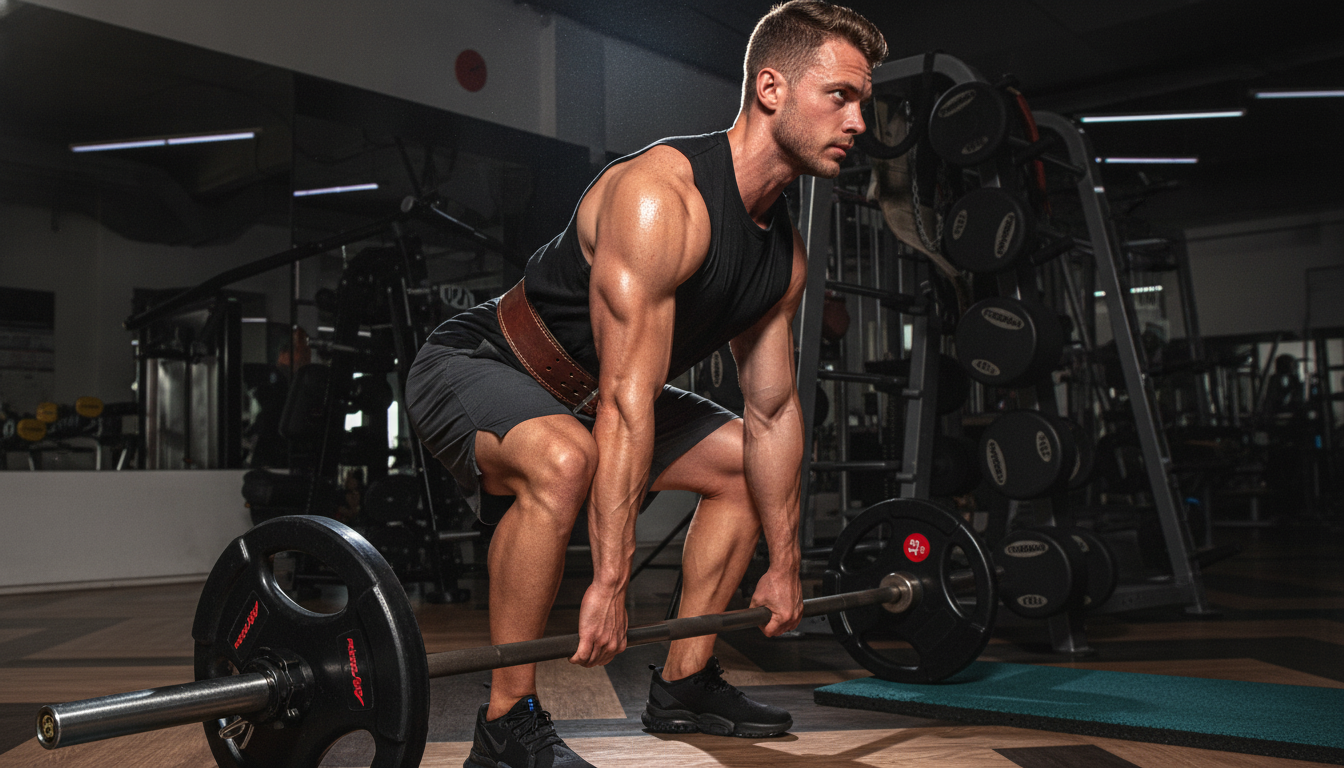
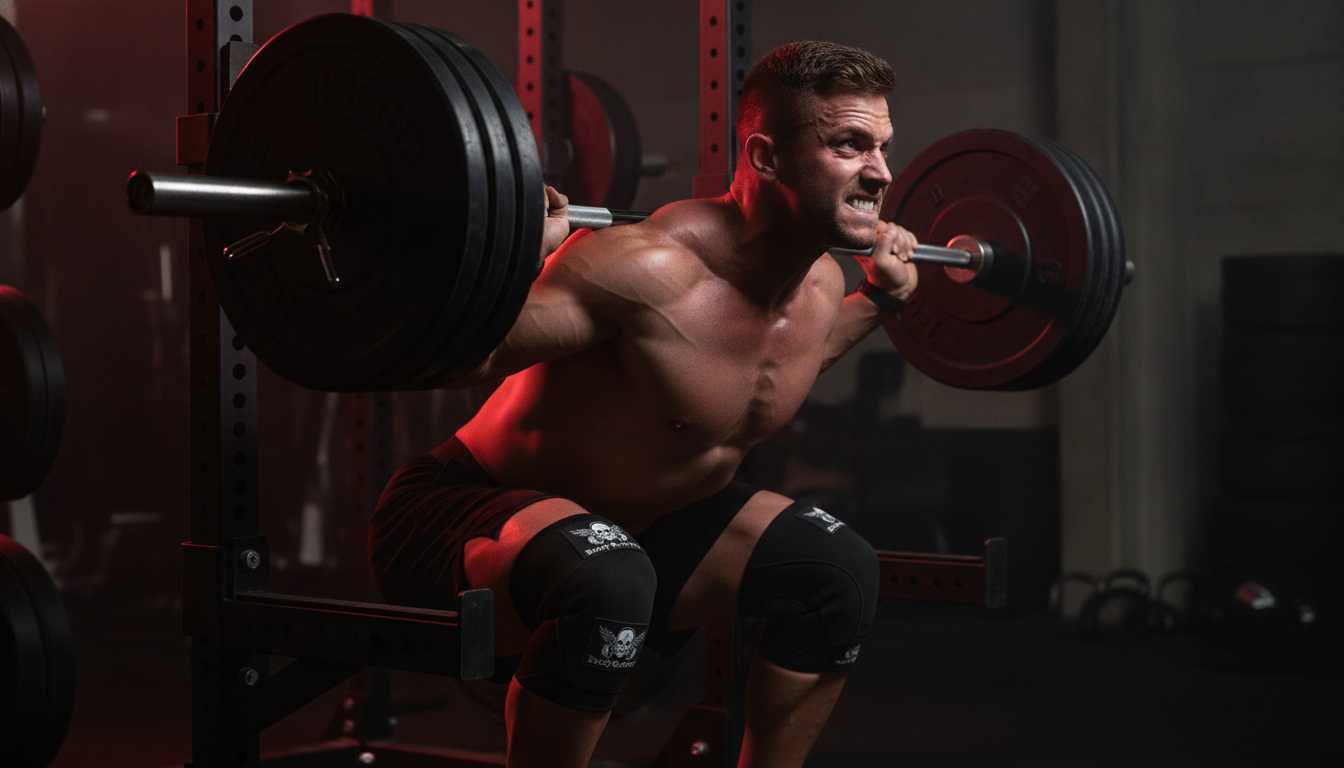

Leave a comment
This site is protected by hCaptcha and the hCaptcha Privacy Policy and Terms of Service apply.