The question hits my DMs at least once a week. "Do knee sleeves actually do anything, or is it just placebo?"
The honest answer is: it depends entirely on what you are asking them to do.
Knee sleeves work. They also get misused more than almost any other piece of gym equipment. The people who dismiss them have usually never worn one that fits correctly. The people who cannot squat without them have usually worn them when they should not have.
Here is the orthopedic PA perspective, built from years of treating knee injuries in competitive powerlifters, recreational gym-goers, and athletes who had no idea why their knees hurt.

What Knee Sleeves Actually Do
Thermal Retention, and Why It Matters More Than You Think
Knee sleeves are made from neoprene, the same synthetic rubber used in wetsuits. Neoprene is a highly effective thermal insulator. When you put a sleeve on, it traps body heat around the joint.
This is not cosmetic. Your knee joint contains synovial fluid, a viscous lubricant that distributes load across the articular cartilage lining the joint surfaces. Synovial fluid is temperature-sensitive. Cold synovial fluid is thicker, flows less efficiently, and provides less even lubrication under load. Warm synovial fluid is more mobile, distributes force more evenly, and allows the joint to move with less internal friction.
The sleeve maintains thermal equilibrium throughout your session. Every rep from warm-up to working set happens at the joint's optimal operating temperature, not at whatever the ambient temperature of your gym happens to be.
If you train in a garage, a cold building, or early morning when the facility has not warmed up yet, this thermal mechanism alone is worth the cost of a sleeve.
Compression and Proprioceptive Feedback
The second mechanism is less discussed but arguably more important for performance.
A properly fitted knee sleeve applies circumferential compression around the joint capsule, the tendons, and the soft tissue surrounding the knee. This compression does two distinct things.
First: it reduces unwanted micromovement in the joint during loaded movement, particularly during the eccentric (downward) phase of a squat, when the knee is under its maximum shear load. Less micromovement means more stable force transfer through the joint and less demand on passive stabilizing structures like the joint capsule and collateral ligaments.
Second: it amplifies proprioceptive feedback. Your nervous system relies on mechanoreceptors in your skin, tendons, and joint capsule to sense joint position and movement in space. Compression stimulates these receptors more strongly than non-compressed tissue. Lifters who wear knee sleeves consistently report better awareness of knee tracking, reduced tendency toward valgus collapse (knees caving inward), and a more reliable sense of bar path. That is not placebo, it is your nervous system receiving a stronger positional signal.
Who Actually Benefits From Knee Sleeves
High-Volume Squatters
If you squat heavy more than twice a week, knee sleeves belong in your training kit. The cumulative load on the patellar tendon, quad tendon, and both knee compartments during a high-volume squat program is substantial. The thermal and compressive benefits compound over time, and lifters over 30 will feel the difference most acutely, since synovial fluid production and connective tissue recovery slow with age. If heavy squatting is central to your program, your belt setup matters just as much, our 10mm vs 13mm lifting belt guide covers how to choose the right thickness.
Lifters Managing Patellar Tendinopathy
Patellar tendinopathy, often called jumper's knee, presents as pain at the inferior pole of the patella during loaded knee flexion. Compressive sleeves reduce the stress on the patellar tendon during the descent phase of squatting by distributing load across the surrounding tissue.
For lifters managing mild to moderate tendinopathy who want to continue training, a sleeve can allow continued loading at a tolerated level while the tendon adapts through a structured rehabilitation protocol. This is not a substitute for an actual loading program. Compression alone will not fix tendinopathy. But it can be a useful adjunct that keeps you training while you address the underlying problem.
Lifters Training in Cold Environments
Garage gyms, early morning sessions in unheated facilities, outdoor programming in cooler months, these all extend the time your joint spends at suboptimal temperature. A sleeve compensates for the environment. The joint reaches operating temperature during warm-up and stays there through the session, regardless of what the room is doing.
When Knee Sleeves Become a Crutch

This is where I have to be direct, because I have seen this pattern in clinical settings and in competitive powerlifting rooms alike.
Some lifters reach a point where they cannot squat without sleeves. Remove the gear and their knees feel unstable, painful, or "wrong." That is not evidence that the sleeves are necessary, it is evidence that the sleeves have been compensating for a structural problem.
Knee sleeves do not fix weak VMO (vastus medialis oblique) activation. They do not correct hip abductor weakness. They do not address valgus collapse under load. They do not fix poor ankle dorsiflexion that is driving compensatory knee mechanics.
If you cannot squat comfortably without a sleeve, the sleeve is not the solution. It is evidence of the actual problem. Get a movement assessment. Work on single-leg strength. Address the root cause. It is the same point I make about why your lower back hurts on deadlifts: supportive gear manages load, it does not fix the mechanics underneath it.
There is also a proprioceptive dependency risk. Your nervous system adapts to inputs. If you train every session with maximum compression, you are training your system to rely on that external signal rather than developing the sensitivity of your own joint receptors. Competitive powerlifters wear sleeves on working sets and remove them for lighter accessory work for exactly this reason, they use the sleeve as a performance tool, not as a permanent brace.
Use knee sleeves to enhance function that already exists. Not to replace function that does not.
How to Wear Knee Sleeves Correctly
Placement
The sleeve should be centered directly on the patella, with equal coverage above and below the kneecap. Most gym-goers wear them too low, pulled down toward the tibial crest, which shifts the compression away from the joint line and patellar tendon, where it is most useful.
Pull the sleeve up until the patella sits in the center of the sleeve. If it migrates down to your shin during warm-up sets, the sleeve is either too large or too loose. Both eliminate the performance benefit.
Tightness
A correctly sized sleeve should be difficult to put on. You should feel meaningful compression the moment it is fully on. If it slides on without resistance, it is too large. A loose sleeve provides none of the proprioceptive signal and only minimal thermal retention.
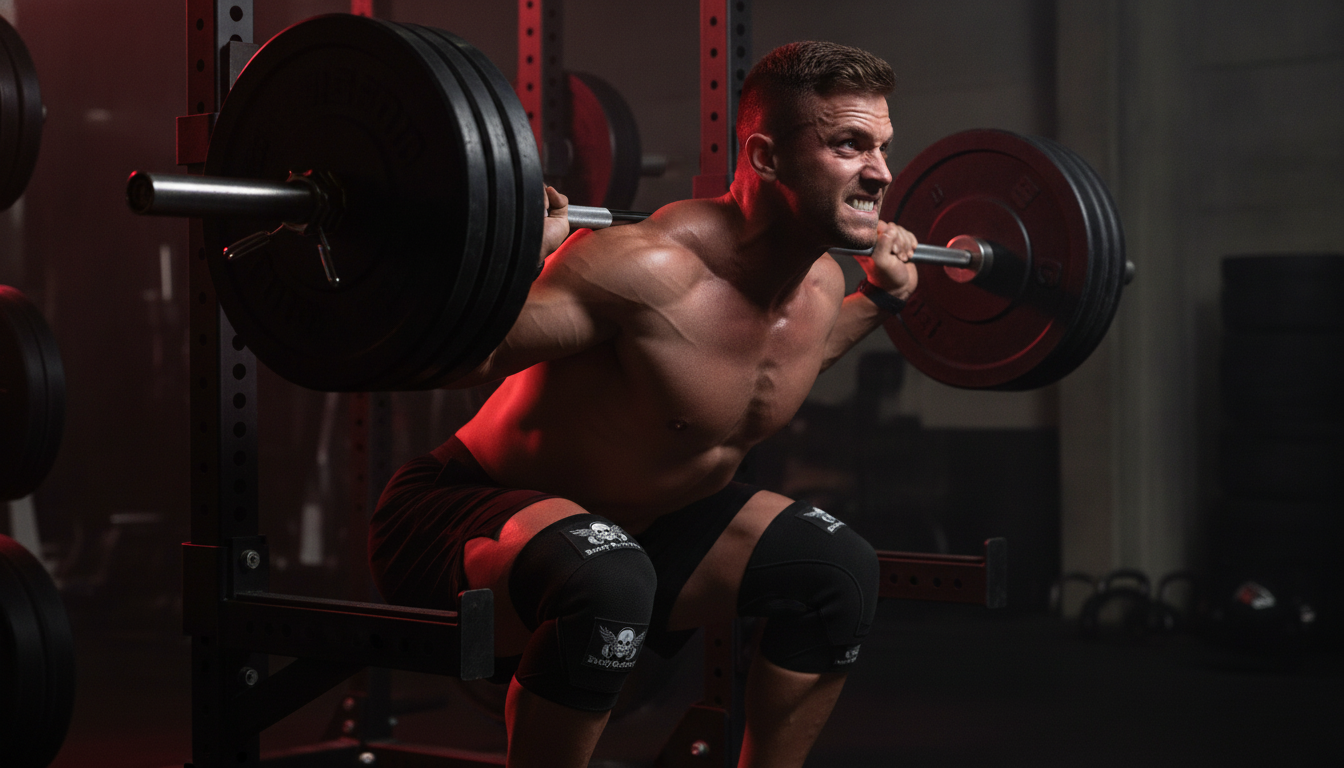
Body Reapers' Neoprene Knee Sleeves are constructed from 7mm neoprene, the thicker, competition-grade gauge built for heavy squat support. If you fall between sizes, size down. The neoprene will loosen slightly over the first 8-12 sessions of use. A sleeve that starts at the correct tension will remain functional far longer than one that starts loose and stretches further with use.
When to Put Them On
Put sleeves on 5-10 minutes before your working sets, not at the beginning of your session. This allows them to trap heat generated during your warm-up, so the thermal benefit is present when it is most needed: during maximal loading, not during foam rolling and dynamic drills.
Do not wear them through your entire session continuously. The proprioceptive enhancement works through contrast, your nervous system responds to the change in sensory input when the sleeve goes on. Wearing them all session, every session, reduces the contrast effect over time.
The Bottom Line
Knee sleeves work. The mechanisms behind them, thermal retention, compression, proprioceptive enhancement, are grounded in joint physiology, not marketing.
They are most useful for high-volume squatters, lifters managing patellar tendinopathy, and athletes training in cold environments.
They are not useful for masking weak stabilizers, correcting valgus collapse, or compensating for poor movement mechanics.
If you are going to wear them, wear them correctly: 7mm neoprene, fitted snugly, centered on the patella, worn during working sets rather than your entire session.
Knee sleeves are joint-support gear, and the same logic applies to your wrists. If you press heavy, when to use wrist wraps breaks down exactly when wrist support earns its place and when it just builds dependency.
If you are choosing a sleeve for performance training rather than light gym use, the Body Reapers Neoprene Knee Sleeves are built for serious squat loads. 7mm neoprene construction, full range of motion, competition-viable. Check the size guide before ordering, fit matters more with knee sleeves than with almost any other piece of lifting equipment.

Recommended Gear


Leave a comment
This site is protected by hCaptcha and the hCaptcha Privacy Policy and Terms of Service apply.