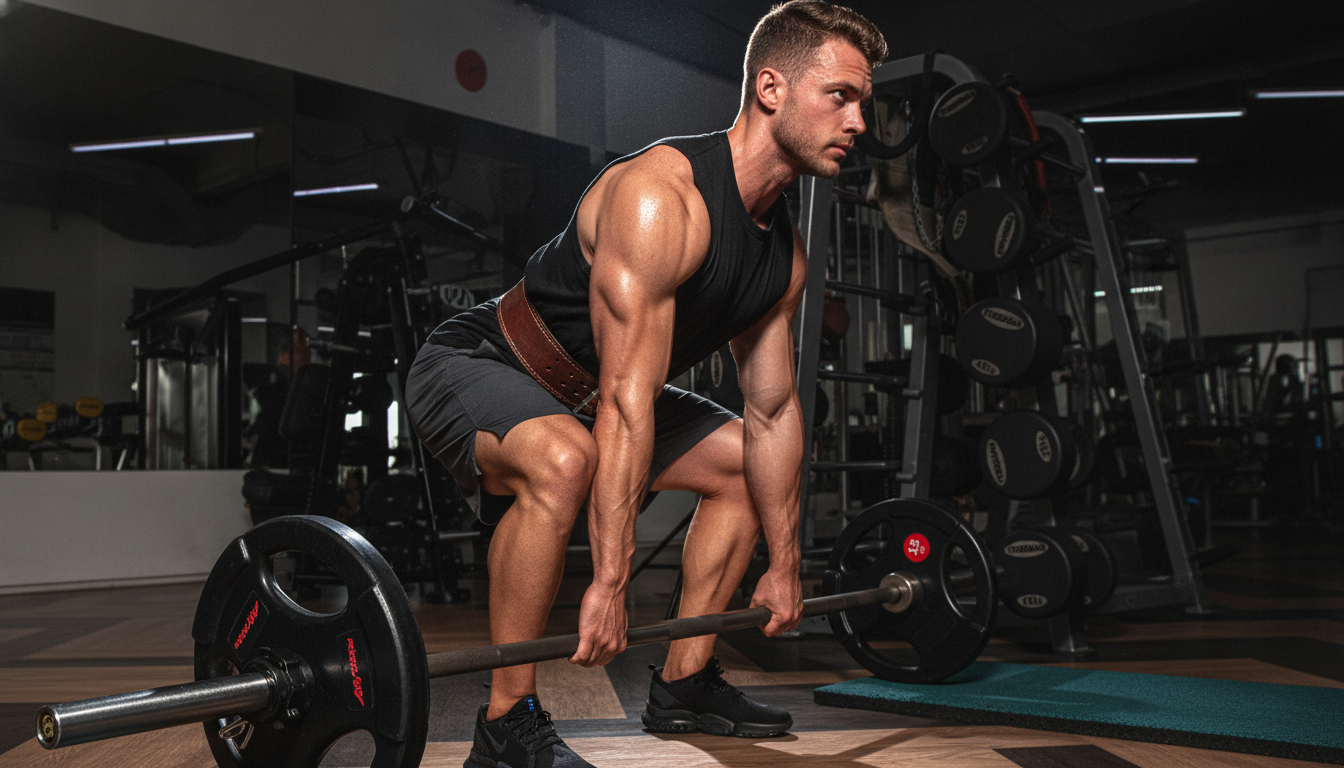
The pain usually shows up in one of two places: a burning ache in the erectors that runs parallel to your spine, or a sharp, localised compression at L4-L5 that you feel most intensely at lockout. Sometimes both. You finish your working sets, you walk out of the gym, and by the time you wake up the next morning you cannot put your socks on without grimacing.
You have already searched the forums. "Your hips are too low." "Your hips are too high." "You're hyperextending at the top." The advice is contradictory, and none of it explains why the same problem keeps coming back even after you fix your form.
Here is what most of that advice misses: the pain is usually not a technique problem. It is a load tolerance problem, and understanding the difference determines whether you fix it in two weeks or spend the next two years managing it.
I am an orthopedic Physician Assistant. I spent over a decade treating spinal injuries before I herniated my own disc in a falling-elevator accident and had to rebuild my training from the hospital bed up. I built Body Reapers because the gear I needed to protect my spine while returning to heavy lifting did not exist. Everything below is what I tell my patients, and what I tell myself.

The Three Mechanical Causes of Deadlift Lower Back Pain
Not all lower back pain on the deadlift comes from the same place. Before you chase a fix, you need to know which of these three mechanisms is driving your pain.
1. Lumbar Flexion Under Load (Butt Wink at the Start Position)
When your lower back rounds as you initiate the pull, your lumbar vertebrae shift from their natural lordotic curve into flexion. Under a loaded barbell, that flexion compresses the posterior elements of the disc. This is the exact mechanism behind posterolateral disc herniation. You may not feel it acutely on the first rep, or even the first session. It accumulates. Each rep adds a small amount of repetitive loading to a disc that is already under compression from the barbell.
This is the cause most coaches address, and they are right to. If your low back rounds before the bar leaves the floor, no amount of equipment will protect you. Fix the movement pattern first.
How to check: Film yourself from the side. Your lumbar curve should be neutral (not exaggerated, not rounded) from the moment you take tension out of the bar through the first 30% of the pull. If your lower back rounds before the bar passes your knees, you have found your problem.
2. Erector Fatigue: Too Much Spinal Extensor Work, Not Enough Bracing
The erector spinae (the long muscles running either side of your spine) are primary extensors, but they should not be the primary stabilisers on a deadlift. That job belongs to your intra-abdominal pressure system: your diaphragm, deep abdominals, and pelvic floor working together to create a rigid, pressurised column that protects the spine from compressive and shear forces.
When bracing is inadequate, the erectors absorb the load they were never designed to carry. You feel this as the deep, burning ache that shows up at moderate weights and worsens set-to-set. It is not weakness in the traditional sense. It is a stabilisation deficit. Your back is working too hard because your core is not.
The fix is a cue, not an exercise: before every rep, take a deep breath into your belly, brace as if you are about to take a punch to the midsection, and hold it through the entire rep. Do not exhale until the bar is back on the floor. This is the Valsalva manoeuvre: it creates the intra-abdominal pressure that stiffens your torso and offloads the erectors.
3. Peak Spinal Load Without Adequate Support at Near-Maximal Effort
The first two causes are trainable. This third cause is where the equipment conversation begins.
At submaximal loads (say, 60 to 70% of your one-rep max) your bracing and technique can usually manage the load. As intensity climbs above 80–85%, the demand on your stabilisation system exceeds what your musculature alone can reliably provide on every single rep of every single set. This is not a personal failure. It is anatomy.
At near-maximal loads, intra-abdominal pressure is insufficient without external reinforcement. The abdominal cavity has elastic walls: your abdominals and diaphragm can only generate so much pressure before the system fails at the margins. This is why competitive powerlifters wear belts in competition. Not for posing. Because the physics of the spine under supramaximal load are not negotiable.

Does a Weightlifting Belt Actually Help, or Is It a Crutch?
This debate never goes away. The clinical evidence gives a clear answer.
A properly fitted weightlifting belt increases intra-abdominal pressure by approximately 40% at a given load. That number comes from multiple peer-reviewed studies including landmark work published in Ergonomics and the Journal of Orthopaedic & Sports Physical Therapy. The mechanism is mechanical: the belt gives your abdominals something to brace against. You push out, the belt resists, pressure increases, spine is supported.
The crutch narrative assumes that belt use prevents your core from developing. It does not, provided you are also training without a belt at submaximal loads. Use a belt for your working sets above 80% and for any set where spinal loading is high. Do not use one for your warm-up sets or accessory work. Your core will not atrophy from appropriate belt use any more than your grip will atrophy from using straps on your heavy rows.
What does function as a crutch is using a belt to compensate for a movement pattern problem. If you cannot keep your lower back neutral without a belt, the belt is masking a technique flaw that will eventually outpace the protection the belt provides. Fix the pattern. Then add the belt for high-intensity work.
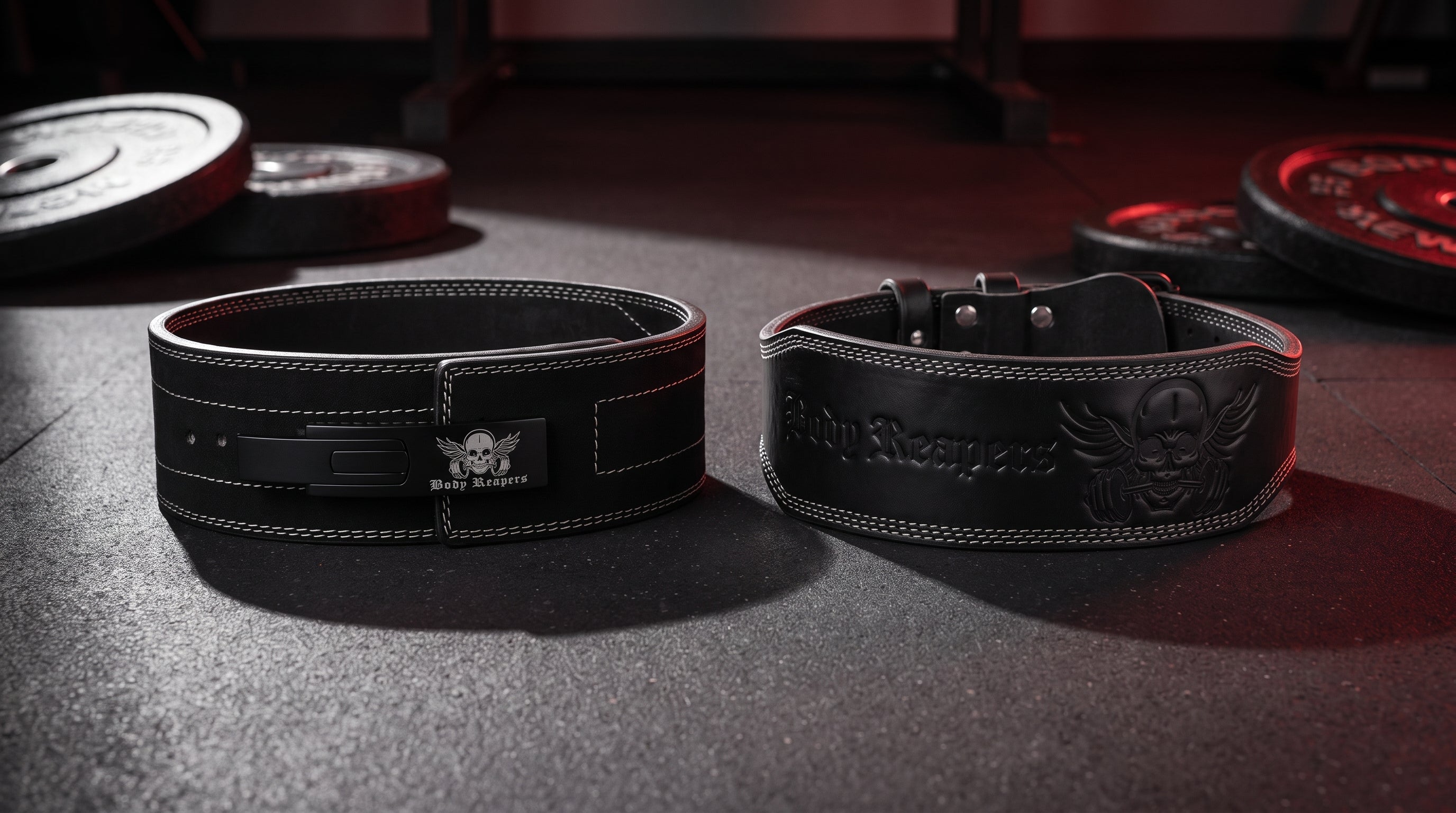
One more point: belt fit matters as much as belt design. A belt that shifts during the pull provides inconsistent pressure, meaning inconsistent protection. The reason I designed Body Reapers around a lever mechanism rather than a prong is exactly this: consistent tension on every rep. You set the lever once. It does not shift, loosen, or give uneven pressure across the buckle. The full clinical case for why lever beats prong on tension consistency is in our lever belt vs. prong belt guide. See our 10mm Lever Belt →
The Lower Back Pain That Does Not Go Away: When to Stop Pushing
Most deadlift lower back pain is mechanical and resolves with technique correction, appropriate loading, and belt support where indicated. But some does not.
Stop training and see a clinician if:
- Pain radiates down one or both legs (possible nerve involvement)
- You have numbness or tingling in your feet or toes
- Pain is present at rest and wakes you from sleep
- You have lost bladder or bowel control (this is an emergency: go to A&E)
A unilateral disc herniation at L4-L5 or L5-S1, the levels most commonly affected in deadlifters, presents as unilateral leg pain, often described as electric or burning, that follows a specific nerve root distribution. Lower back ache alone is almost never nerve-related. Pain down the leg almost always is. Know the difference before you push through.
The Summary Version
Lower back pain on the deadlift has three causes: lumbar flexion under load (technique), erector overload from inadequate bracing (coaching), and insufficient intra-abdominal pressure at near-maximal effort (load management and equipment). The first two are fixed by movement pattern work. The third is where a quality belt earns its cost.
Your lower back is not weak. It is either unsupported or over-demanded. There is a significant difference between those two problems, and the right answer to each is not the same.
Train with intent, brace on every rep, and use a belt for your heavy working sets. If the pain has moved from your lower back into your leg, that is a different clinical picture and pushing through it is the wrong call. See a clinician before returning to load. The same principle of using gear to support load rather than compensate for dysfunction runs through every piece of kit in a serious lifter's bag. Our knee sleeve guide applies identical logic to the knee joint, including when compression becomes a crutch.
Rawal Mushtaq is an orthopedic Physician Assistant with over a decade of clinical experience in sports medicine and spine injury rehabilitation. He is the founder of Body Reapers and designed the brand's core product line from his knowledge of joint mechanics, injury prevention, and what it takes to return to heavy training after spinal injury.

Shop the Body Reapers 10mm Lever Belt →
Recommended Gear


Leave a comment
This site is protected by hCaptcha and the hCaptcha Privacy Policy and Terms of Service apply.