The Q-Angle Problem
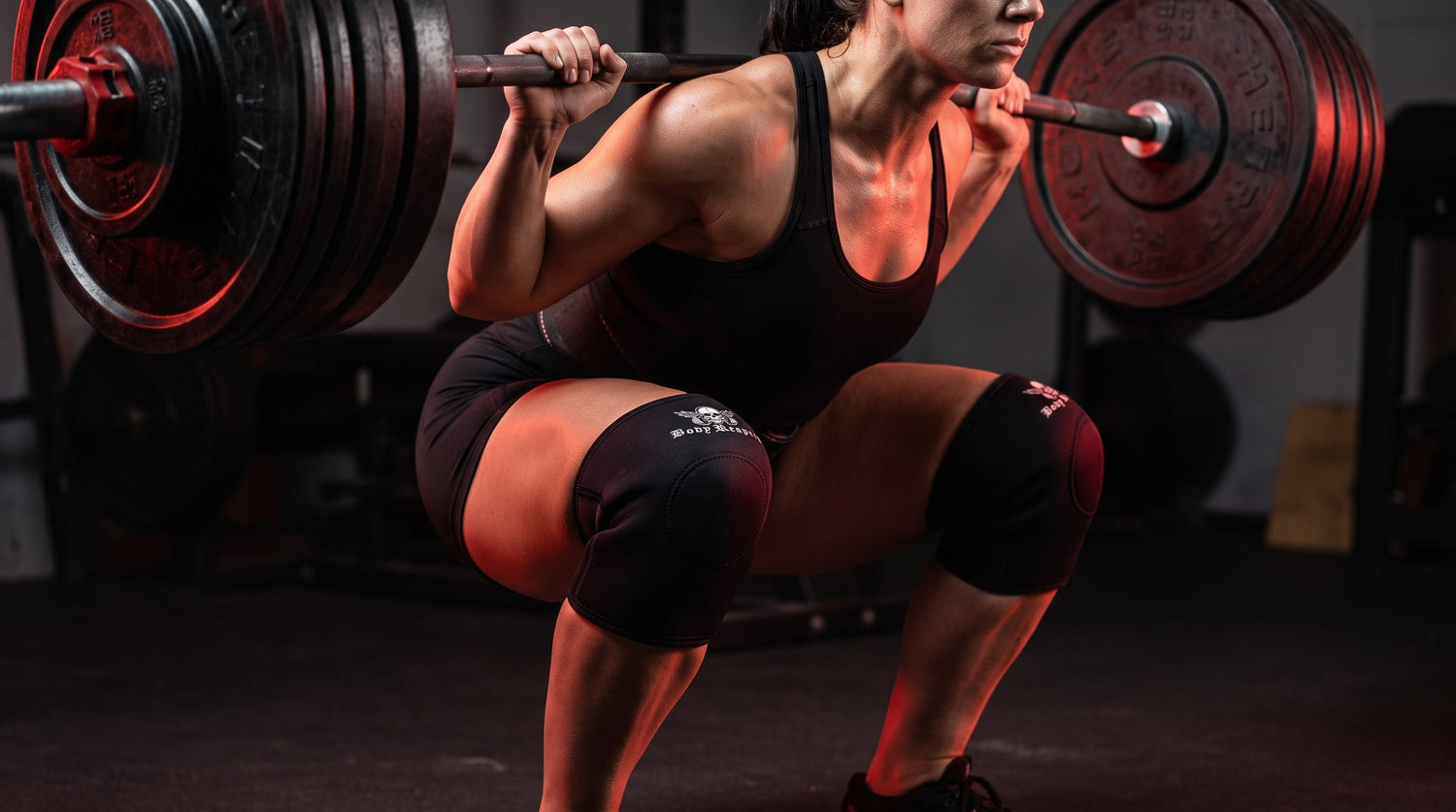
In clinic, the knee complaint I saw most often in women powerlifters followed the same pattern: no history of knee trouble, a squat that had been climbing steadily for months, then a sharp pain under the kneecap on the descent. Not a single acute injury, a gradual one, the kind that builds quietly across a training block and then announces itself under a heavy single.
The cause usually traces back to anatomy, specifically the Q-angle: the angle between the line of pull from the hip and the line of the patellar tendon. Standard clinical references put the average Q-angle at around 17 degrees for women and around 12 for men, and once it climbs past roughly 20 degrees the kneecap tends to track outward under load. A wider pelvis, a shorter femur, and more inward twist of the thigh bone all push a woman's Q-angle higher on average. With that geometry, every squat rep loads the patella a little asymmetrically, driving stress outward and down toward the patellar tendon. Add a program with no patellar-specific support work, and cumulative strain becomes the predictable result.
This is the conversation nobody's having about knee sleeves for women.
Women's Knees Load Differently
I need to say this plainly: women's knees do not load the same way men's knees do. It's not that women are weaker. It's biomechanics.
Women have:
- A larger Q-angle (hip width relative to knee width). This means the force vector from your glutes and hip flexors pulls your knee inward during a squat, creating valgus (inward) stress.
- Greater hip external rotation, less hip internal rotation. This compensatory hip position during heavy squats increases patellofemoral compression, meaning more force pressing the kneecap into the femur. Over high-rep cycles, this creates chronic stress.
- Relatively longer femurs and narrower knees. The proportional anatomy means the patellar tendon experiences higher tensile load per pound of squat weight compared to a male lifter with the same total-body strength.
This isn't a fringe observation. It's consistent with the standard sports-medicine literature on patellofemoral mechanics: a wider Q-angle and greater relative hip mobility predispose women to earlier patellar-tracking issues under load.
That doesn't mean you can't squat heavy or push hard. It means you need intelligent joint protection when strength training. The right strategy combines equipment, strength work, and load management.

Patellar Tendon Strain: The Real Risk
The patellar tendon connects your quad muscle to your shinbone. Every time you squat, your quad fires hard to extend your knee, and the patellar tendon absorbs the brunt of that force. Under heavy loads (especially below-parallel squats or leg press), the tendon can micro-tear. One tear is not a problem; 50 repeated micro-tears over six weeks is cumulative injury.
Here's the mechanism: during the descent of a squat, your quad muscle lengthens while under tension (eccentric loading). Simultaneously, your knee bends, the patella glides, and the patellar tendon stretches. In women with a high Q-angle, that glide isn't smooth. The kneecap pulls slightly outward as the knee bends. The patellar tendon spirals. Repeat this 20 times, and the tendon starts to fray.
A neoprene knee sleeve doesn't "fix" your anatomy. What it does:
- Improves patellar tracking: the compression holds your kneecap centered in its groove. This reduces that spiral I described.
- Increases proprioceptive feedback: you feel more "locked in" to the movement, which improves motor control and reduces compensatory stress.
- Maintains warmth during heavy sets: inflammation decreases when the joint temperature rises. Less inflammation means less pain and faster recovery of microtrauma.
- Reduces vertical shear: the compression dampens upward-and-downward forces on the patellofemoral joint, especially on the descent of a squat.
All of this means: lower cumulative injury load per rep.

Why Standard Sizing Fails Women
Here's where most women go wrong with knee sleeves: they buy based on calf size or a generic guess instead of their actual knee measurement.
A standard sizing chart says: "Size 7mm if your calf is 13-14 inches." But women's knees and calves have different proportions than men's. A woman with a 13-inch calf and a 7-inch knee will have a sleeve that's either too loose on the knee (no support) or too tight at the calf (circulation cut off during heavy sets, which you definitely feel on rep 8 of a squat).
The right approach:
Measure at three points:
- Knee circumference (directly at the center of your kneecap, in standing position): the primary measurement
- Calf circumference (widest part of the lower leg, 4 inches below the knee): secondary, for comfort
- Thigh circumference (4 inches above the knee, standing relaxed): check if you're a taller athlete or have significant quad size
Sizing: Measure your knee circumference at the center of the kneecap, then match it to the size chart on the product page, which runs S through XL. If you land between two sizes, size down for more compression or up for comfort.
The Body Reapers neoprene knee sleeves come in a full size run from S to XL, so match the sleeve to your knee measurement rather than guessing off a calf-based chart. If you're deciding between 5mm and 7mm thickness, our detailed guide to compression depth breaks down which thickness fits your training style and load range.
When Sleeves Help; When They Don't
I see lifters treat knee sleeves like a magic fix. They aren't.
Sleeves WILL help if:
- You have patellar tracking issues (kneecap pain under load, pain on descent, pain worse in high-rep work)
- You have a high Q-angle (you know this if you have a coach, or if you've noticed your knees cave inward under load)
- You're doing high-rep leg press, squats, or leg extensions (cumulative load, not ballistic strength)
- You're recovering from knee surgery or tendinopathy
- You're a woman with standard-to-high hip mobility: sleeves help you control that excess mobility under load
Sleeves WON'T help if:
- You have true ligament damage (ACL, MCL tears). Sleeves provide zero ligament support.
- You have bone-on-bone osteoarthritis. Sleeves reduce pain by improving tracking and warmth, but they're not a substitute for load management and PT.
- Your knee pain is coming from hip weakness. If your glutes aren't firing, a sleeve won't fix poor motor control.
What to do instead: If you have pain, get an assessment. A physical therapist or sports medicine PA can tell you if the issue is tracking, ligament, or motor control. Only then buy sleeves (if appropriate).
The Protocol That Works
Sleeves on their own don't solve a tracking problem. The approach I use in clinic addresses three things at once: anatomy, strength, and load.
- Sleeves on every squat and leg-press session, not just heavy days. Low-rep work still loads the patellar tendon, and the proprioceptive benefit of the sleeve matters even at three reps.
- Quad-specific strength work, two to three times a week. Single-leg work (Bulgarian split squats, Copenhagen adductor holds, banded terminal knee extensions) targets the vastus medialis obliquus (VMO), the part of the quad that helps center the kneecap. The Q-angle itself is anatomical and won't change, but VMO strength influences how the patella tracks.
- Load management. Trading one heavy squat session for a lighter paused-squat technique day, and adding slow eccentric leg press (three seconds on the descent), builds tendon resilience while cutting cumulative patellar load. Eccentric work is what strengthens the collagen in the tendon.
It works because it addresses the root, not just the symptom: tracking (sleeves), the strength gap (VMO work), and volume (load management). Any one of the three on its own tends to fall short.
Sizing for Your Competition Cycle
If you're in a 16-week prep for a meet, here's when sleeves make the most sense:
- Weeks 1-4 (hypertrophy): Wear sleeves. High reps mean cumulative load; sleeves matter more in volume work than in strength work.
- Weeks 5-12 (strength and competition simulation): Wear sleeves. This is when intensity rises and technique fatigue creeps in, so sleeve support and feedback keep your tracking dialed.
- Weeks 13-16 (meet prep, peak): Wear sleeves in training, meet day if your federation allows it. (IPF and USAPL both allow 7mm sleeves.)
Don't introduce sleeves for the first time in week 14. Your knee needs 4+ weeks to adapt to the proprioceptive feedback and compression. If you start wearing them late in prep, you may actually feel less stable on meet day if you're not used to the sensation.

Our Pick for Patellar Support
The Neoprene Knee Sleeves are our pick for patellar support. 7mm neoprene gives firm compression to help center the patella and keeps the joint warm on high-rep days. They come in a full S-to-XL size run, so you can match the sleeve to your knee measurement instead of guessing off a calf-based chart. At $34.99, they're the right price point for an athlete building her injury-prevention kit.
Browse our full knee collection for other compression depths and sizes.
Recommended Gear


Leave a comment
This site is protected by hCaptcha and the hCaptcha Privacy Policy and Terms of Service apply.