
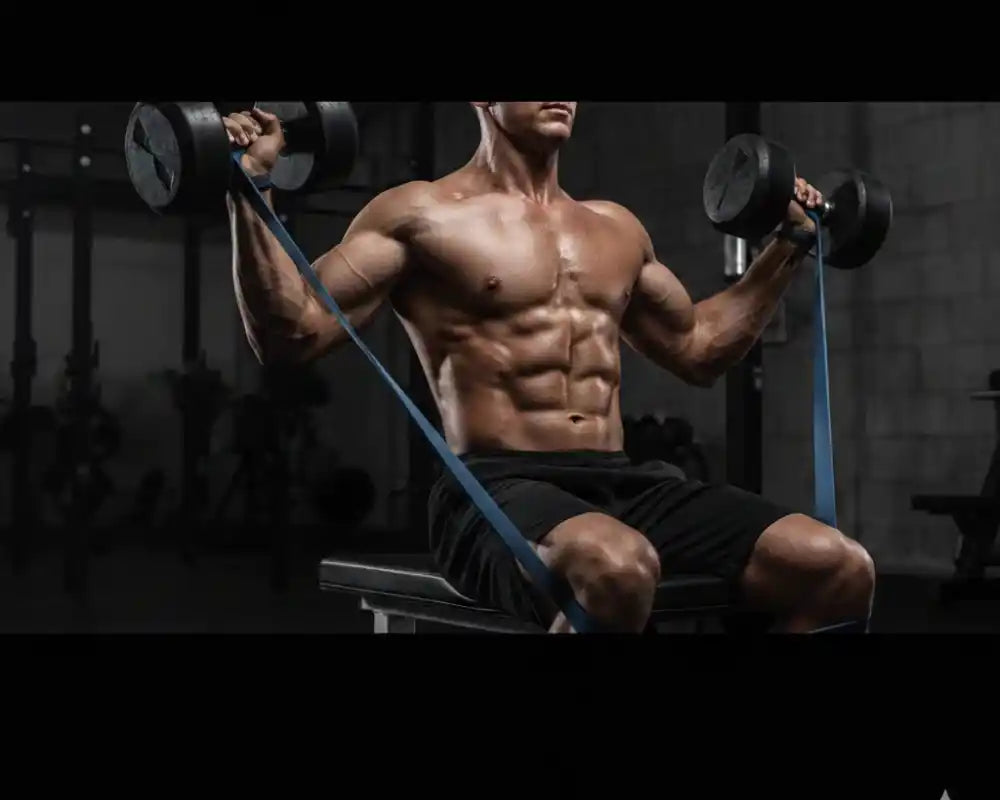
Most lifters hit a frustrating wall. You add weight to the bar. You push through more reps. Yet progress slows. The problem is not your effort. The problem is your tools. Traditional weight lifting misses a key growth stimulus. Combining resistance bands with free weights fixes this.
This is not a trendy hack. It is a proven training method called accommodating resistance. Professional athletes and coaches use it. Today, you will learn how to apply it. This guide explains why adding resistance bands to dumbbells works. You will learn the exact setup. You will get a complete workout plan. Prepare to break through your plateau.
Why Gravity Alone Limits Your Gains
Free weights rely on gravity. A 50-pound dumbbell feels heaviest at the bottom of a curl. As you lift it, the challenge decreases. Your muscle works hardest in one position. It relaxes in others and limits total muscle tension. Total tension is what drives growth.
Resistance bands work differently. Their tension increases as you stretch them. At the top of a movement, the band pulls hardest. This matches your muscle's natural strength curve. Your bicep is strongest when fully flexed. A band provides maximum resistance right there, creating constant tension. Constant tension triggers greater recruitment of muscle fibers. More recruitment means more growth.

A 2017 study in the Journal of Strength and Conditioning Research found this method superior. Subjects using bands with free weights gained more strength. They saw better performance improvements than the free-weight-only group. The science is clear. Bands and weights together are more effective.
Recommended: Best Workout Bands for Strength Training
Full-Body Workout Using Resistance Bands: Maximize Your Fitness Routine
Your Complete Setup Guide: Methods & Safety
Safety and effectiveness start with proper setup. Follow these methods.
The Loop Band Method
The Loop Band Method is the most common technique. It works for presses, rows, and squats.
- Place the loop band flat on the floor.
- Set your feet shoulder-width apart on the band's middle.
- Grab your dumbbells. Loop the band's ends over the top of each dumbbell head.
- Assume your lifting stance. The band should be taut before you begin.
Tube Band Method
Use this for curls, extensions, and shoulder raises. You need bands with handles.
- Thread the band under your feet or a sturdy anchor.
- Pull the handles up. Place them in your palms.
- Grip your dumbbells over the band handles. Your hand will hold both.
- Perform the exercise. The band will add resistance throughout.
The Tube Band method offers excellent control for isolation exercises.
Top Banded Dumbbell Exercises for Total Growth
Apply these techniques to key movements. Transform your training.
1-Banded Dumbbell Bench Press
This exercise fixes the weak lockout problem. The band makes the top portion hardest.
- Use the loop band method. Lie on your bench.
- Press the dumbbells as you normally would. Feel the band's pull increase. Control the descent against the band's tension.
- Powerful lockout. Controlled negative.
2- Banded Goblet Squat
Build explosive power from the bottom position. The band teaches you to drive up with force.
- Stand on a loop band. Hold one dumbbell vertically at your chest. Loop the band over your wrists or the top of the dumbbell.
- Squat down. As you rise, fight the increasing band tension.
- Driving through your mid-foot. Maintaining torso upright.
Also Read: 5 Best Chest Exercises Using Resistance Bands for Strength and Growth
3- Banded Dumbbell Row
Eliminate momentum. Force a powerful muscle contraction at the top.
- Place a loop band under your feet. Hold your dumbbells. Loop the band over the dumbbell heads.
- Row the weights to your hips. Squeeze your shoulder blades together against the band's pull.
- Peak contraction. No body swing.
4- Banded Dumbbell Curl
The Banded Dumbbell Curl is the ultimate constant-tension bicep builder. No rest at the top.
- Use the tube band method under your feet.
- Curl the dumbbells. Feel the band fight you hardest at full flexion.
- Slow tempo. Full range of motion.
Answering Your Top Questions
Q: Can I use bands to make light dumbbells more challenging?
Yes. This is a brilliant home gym strategy. The band adds meaningful resistance where you are strongest. This makes a lighter dumbbell effective for hypertrophy. It is a smart way to progress without buying heavier dumbbell sets.
Q: Should I stop using regular dumbbells now?
No. Do not replace traditional weight lifting. Use this as a strategic tool. Add banded work to 1-2 key lifts per session. Use standard dumbbells for others. This combination delivers the best long-term results. It prevents adaptation
Q: Are banded dumbbell exercises safe for my joints?
Yes, when performed correctly. The accommodating resistance can be gentler. There is no jarring impact at the end of the movement. Always start with a lighter band tension. Master the movement pattern. Then progress. Listen to your body.
The Next Step for Serious Lifters
You now understand the power of combining resistance bands with free weights. This method solves the plateaus caused by gravity-based training. You have the science. You have the setup guide. You have the workout.
But knowledge alone is not enough. You need the right equipment to execute. Flimsy bands snap. Poor handling slips. This ruins your workout and poses a risk.
If you want non-slip, orthopedically inspired fabric resistance bands designed for real training, explore BodyReapers resistance systems.
Built for biomechanics.
Built for progress.
Built to last.
Take action now. Combine the knowledge. Apply the method. Use the right tools. Your breakthrough starts today.
Recommended Gear


Leave a comment
This site is protected by hCaptcha and the hCaptcha Privacy Policy and Terms of Service apply.