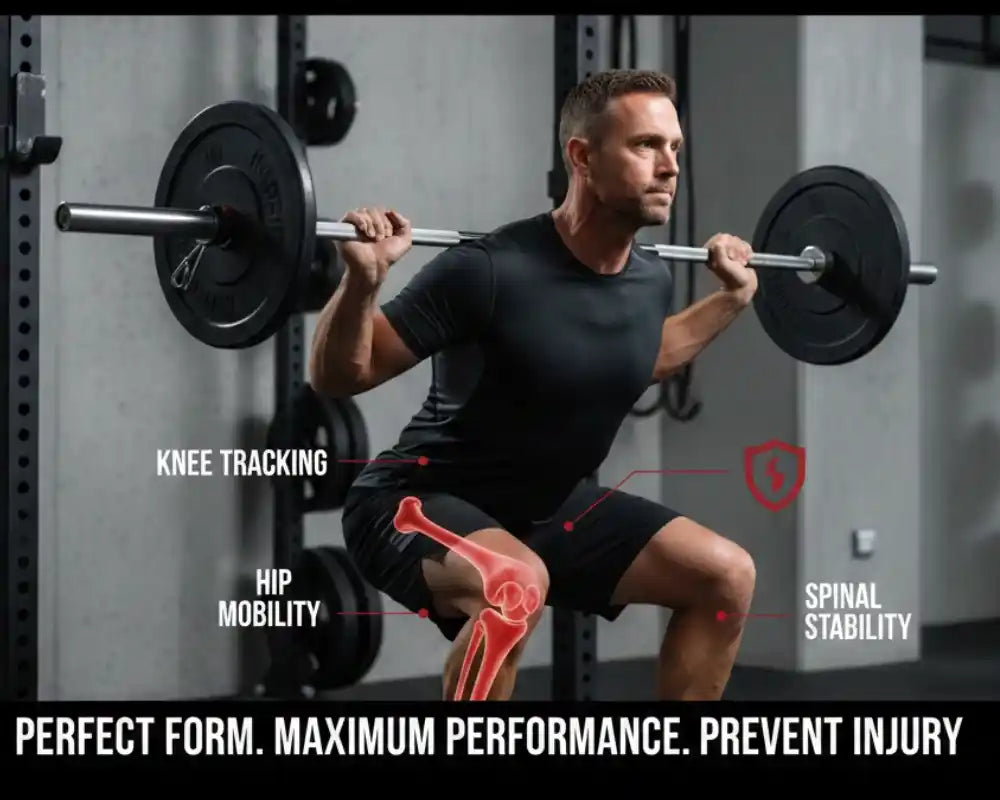
Squats are one of the most effective exercises for building lower-body strength, muscle mass, and athletic performance. However, poor technique, improper load management, and lack of joint support often lead to common squat injuries, especially in the knees, lower back, hips, and wrists.
The truth is simple: Most squat injuries are preventable when training respects anatomy, biomechanics, and intelligent progression.
This guide explains how squat injuries happen and how to avoid them using a holistic, proactive system engineered from orthopedic logic, not guesswork.
The Prevention Mindset: Why Squat Injuries Happen
Squat injuries rarely come from one bad rep. They develop when small technique flaws repeat under load, slowly wearing down tissue over time.
Think of your joints like a credit card. Poor form, limited mobility, too much volume, and ego lifting are charges. Recovery, smart programming, and sleep are payments. If you keep charging without paying down the balance, injury is simply the moment your body says, “Enough.”
True prevention is proactive. It’s about managing your movement quality, load, and recovery so you can perform pain-free.
Explore More: Reasons for Lower Back Pain When Squatting
Squat Straps: Complete Guide to Pain-Free Front Squats & Better Form
The Most Common Squat Injuries (and What Causes Them)
1. Lower Back Pain During Squats
Symptoms
Stiffness after training, aching that gets worse with more volume, or sharp pain when coming up out of the squat.
Root Cause
The primary problem is improper core brace. Your spine becomes unsupported in the absence of significant intra-abdominal pressure. Your lower backbone discs will be dangerously stressed if you add excessive forward lean or rounding at the bottom.
Fatigue makes it worse. When your stabilizers tire, your spine compensates, and breakdown follows.
How to Prevent It
Prevent lower back injuries by mastering diaphragmatic breathing and bracing. Create a rigid core before you descend and keep it tight the whole lift. Increase weight slowly, and only go as deep as you can while keeping your spine neutral.
A lifting belt isn’t a crutch. It’s a tool. Our doctor-designed weightlifting belts are contoured to support your spine’s natural movement. They give you something to brace against, improving stability without replacing good technique.
2. Knee Pain During Squats
One of the most common and misunderstood squat injuries.
Symptoms
Pain under or around the kneecap, especially at the bottom of the squat or after training.
Root Cause
Knee pain during squats is rarely just a knee issue. Weak glutes let the knees cave inward, throwing off kneecap tracking. Tight ankles force the knees to compensate, adding stress to tendons and ligaments.
How to Prevent It
Fix the chain, not just the joint. Strengthen your glutes to keep your knees aligned. Improve ankle mobility so you can hit depth without strain. Focus on keeping your knees in line with your toes throughout the movement.
Knee sleeves don’t replace strength, but they improve joint awareness, warmth, and stability, helping you maintain better form under load. Our sleeves support natural movement, not restrict it.
3. Hip Impingement and Strain
Symptoms
A pinching feeling at the bottom of the squat, deep hip pain, or gradually losing squat depth over time.
Root Cause
Everyone’s hip anatomy is different. Forcing depth beyond your individual structure creates conflict inside the joint. Tight hip flexors pull your pelvis out of position, making the problem worse with every rep.
How to Prevent It
Respect your anatomy. Squat to a depth that is strong and stable, not forced. Strengthen your hip flexors and stabilizers for better control, and work on mobility that supports your squat, not destabilizes it.
Body Reapers Hip Flexion Bands apply tension where your anatomy needs it, improving both mobility and strength. This is targeted preparation, not random stretching.
4. Wrist and Shoulder Pain
Often overlooked, upper-body issues can ruin your squat by making the bar unstable.
Root Cause
Stiff upper back and poor bar position force your wrists into extreme angles. Under heavy weight, this stresses tendons and weakens your whole setup.
How to Prevent It
Create a stable upper back shelf and position the bar properly to take stress off your wrists. If mobility is limited, use supportive gear to protect your joints without sacrificing performance.
Our wrist wraps and lifting straps are designed to protect your tendons while letting you perform. Your grip shouldn’t be the weak link in your squat.
Squats should build your body, not break it.
Most squat injuries are preventable when you train with respect for biomechanics, your own anatomy, and intelligent support. At Body Reapers, every product is built with medical insight and orthopedic logic because when you understand how the body breaks, you design differently.
Recommended Gear



Leave a comment
This site is protected by hCaptcha and the hCaptcha Privacy Policy and Terms of Service apply.