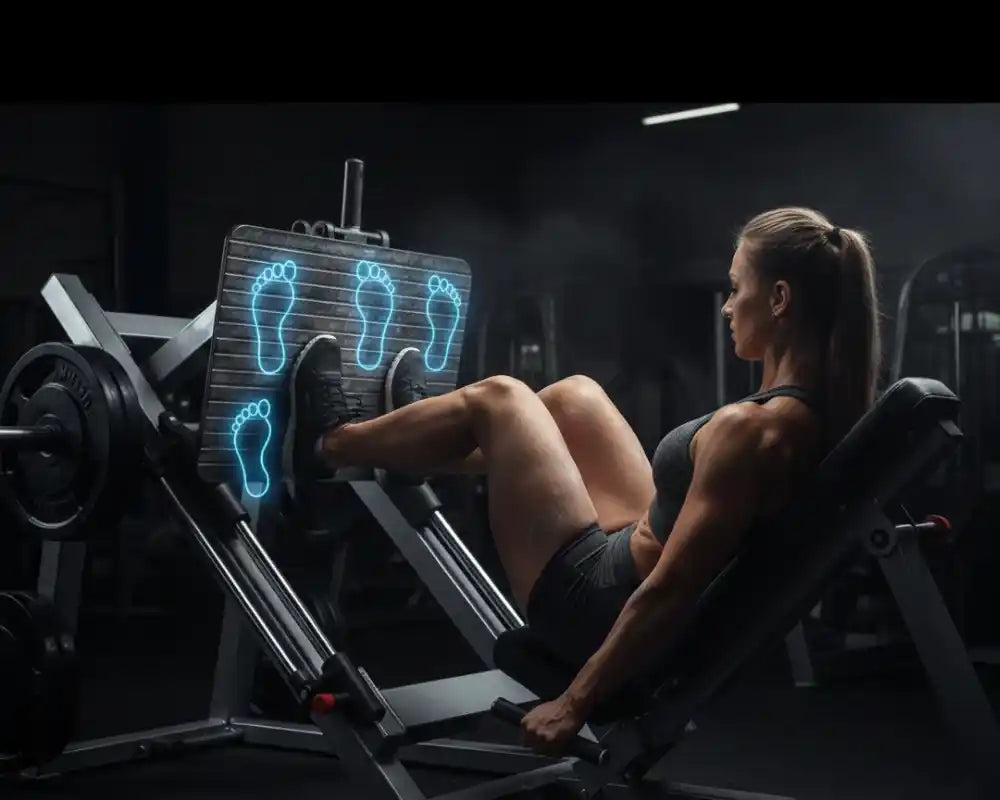
Many lifters push heavy weights on the leg press. They feel it only in their knees or joints. They miss the deep muscle burn that sparks real growth. The problem is rarely effort. It is the foot position.
Your leg press foot placement controls everything. It decides which muscles work hardest. It determines joint stress. Mastering this turns a generic leg day movement into a precision tool.
After years of coaching, seven specific stances deliver consistent results. Each stance serves a distinct purpose. This guide explains each one. You will learn how to place your feet for the quad sweep, activate your glutes, and develop your hamstrings. You will also learn to protect your knees.
Foundational Rules: How to Place Feet on the Leg Press Safely
Before exploring stances, follow these non-negotiable rules. Proper leg press foot position ensures safety and effectiveness.
- Keep your entire foot flat on the platform. Never push only with your toes.
- Maintain your lower back and tailbone pressed firmly against the seat pad.
- Do not lock your knees at the top of a repetition.
- Lower the platform under control until your knees form at least a 90-degree angle.
-
Your chosen leg press stance should never cause pain in your knees or hips.
These rules apply to every variation. Now, let us break down the seven key placements.
1. The Standard Shoulder-Width Stance
This is the default position for balanced development.
Foot Placement: Place your feet shoulder-width apart. Center them on the platform. Keep your toes pointed straight or pointed out.
Muscles Targeted: The wide-stance squat effectively targets the quadriceps, glutes, and hamstrings in equal measure, building overall strength very efficiently.
Application: Drive through your entire foot, not just your heels, to build foundational leg power. This stance is best for anyone new to the leg press and for performing heavy, strength-focused sets.
2. The High Foot Placement (For Glutes and Hamstrings)
A high foot position prioritizes the posterior chain.
Foot Placement: Position your feet high on the platform. Your toes should be near the top edge. Keep your feet shoulder-width apart.
Muscles Targeted: This is the best leg press foot placement for glutes and hamstrings. It closely mimics a hip thrust motion.
Application: Focus on pushing the platform away by driving your heels down and squeezing your glutes at the top. Use this stance to build stronger, more powerful glutes as an excellent accessory after squats or deadlifts.
3. The Low Foot Placement (For Quad Sweep)
A low position increases knee flexion. This places maximum tension on the quadriceps.
Foot Placement: Position your feet low on the platform. Your heels should be near the bottom edge. Maintain a shoulder-width stance.
Muscles Targeted: This is the ultimate leg press variation for quads. It emphasizes the teardrop-shaped vastus medialis muscle.
Application: Ensure your heels stay flat. If they rise, your feet are too low. Do not let your hips curl under the pad. This stance is best for bodybuilders seeking quad definition and sweep to build mass on the front of the thighs.
Related: Leg Press vs Squat: Which is Better for Strength Training?
4. The Wide Stance Leg Press (For Inner Thigh and Glutes)
A wide stance increases hip abduction and internal rotation.
Foot Placement: Place your feet wider than shoulder-width. Position them high on the platform. Point your toes out at a 45-degree angle.
Muscles Targeted: This stance targets the inner thighs (adductors) and glutes. It is excellent for building a wider, more powerful hip structure.
Application: Imagine driving your heels apart at the bottom as you push up, feeling a nice stretch in your groin. Ideal for building the strength of the inner thigh, hip joint mobility, and squat and sumo deadlift stability.
5. The Narrow Stance Leg Press (For Outer Quads)
A narrow stance focuses work on the outer quadriceps.
Foot Placement: Place your feet close together, about hip-width or narrower. Center them on the platform. Toes point forward.
Muscles Targeted: This narrow stance leg press hammers the vastus lateralis, the outer quad muscle. It creates the "quad sweep" from the side.
Application: Lower the platform deeply with control, as a narrow stance increases the quads' range of motion. Use this with moderate weight and higher reps to isolate the quadriceps and build the outer leg contour.
6. The Single-Leg Foot Placement (For Imbalances and Stability)
Training one leg at a time builds joint stability and fixes imbalances.
Foot Placement: Place one foot in the center of the platform, with your other foot firmly on the ground or on the base of the frame.
Muscles Targeted: The leg of the working arm you are working. It is also great at engaging, testing, and stabilizing your core and stabilizing musculature.
Application: Use significantly less weight, focusing on controlled movement and preventing your hips from shifting. This is best for correcting strength differences between legs and serves as a valuable rehab and prehab tool.
7. The Calves-Specific Placement
The leg press is an outstanding tool for building calf mass.
Foot Placement: Place the balls of your feet on the very bottom edge of the platform. Your heels hang off. Keep your knees slightly bent and locked in place.
Muscles Targeted: This isolates the gastrocnemius and soleus muscles of the calf.
Application: Use a full range of motion by lowering your heels as far as possible, then pressing up to a full calf flex. This placement is best for adding mass and strength to often-stubborn calf muscles.
How to Program These Leg Press Stances
Do not use all seven stances in one workout. That strategy leads to fatigue, not focus.
Apply these stances with intent. Choose one primary stance based on your weekly goal. For example, use a low foot placement for quads on your quad-focused day. Use a high foot placement for glutes on your posterior chain day.
Use a second, different stance as a finisher with a lighter weight and higher reps. For example, follow heavy squats with 3 sets of a wide stance leg press for 15 reps to flush the glutes.
Leg Press Foot Placement FAQs
Is the leg press bad for your knees?
No, not when performed correctly. Proper leg press foot placement and stance is critical. A stance that is too narrow or too deep can increase shear force. Listen to your body. The right stance should feel strong and stable, not painful.
What is the best all-around leg press foot placement?
The standard shoulder-width stance is the best for general strength. It balances development across all major leg muscles. It is the safest place to start and load heavily.
What leg press foot placement works the inner thigh?
A wide stance leg press with toes pointed outward targets the inner thighs (adductors). Ensure your feet are also placed high on the platform to maintain hip health.
The placement of your feet will determine the type of leg press results you get. Do not just push weight. Direct it.
Have a plan for your next leg session. Choose one primary position from this guide. Perform this movement slowly and carefully. Feel the target muscles working. Your growth will follow.
Recommended Gear


Leave a comment
This site is protected by hCaptcha and the hCaptcha Privacy Policy and Terms of Service apply.