
You load the bar. You bend over. You pull with all your strength. But your back does not grow. Your lower back screams in protest. This frustration is common. The problem is rarely effort. The problem is technical execution.
The barbell row builds a powerful, thick back. It develops total body strength. But small form errors sabotage progress. They turn a mass builder into a pain generator.
Correct these seven barbell row mistakes. Transform your pull. Build the back you deserve.
Mistake 1: The Rounded Back
The Pain Point: You feel a sharp pinch or ache in your lower back during or after rows.
Why It Is a Mistake: A rounded spine places dangerous stress on lumbar discs. Research in the Journal of Orthopaedic & Sports Physical Therapy highlights that spinal flexion under load significantly increases injury risk. Your back muscles cannot work effectively from this weak position.
The Fix: Set your spine before you pull.
Stand with feet shoulder-width apart.
Hinge at your hips until your torso is near parallel to the floor.
Lift your chest and tighten your core. Your spine should form a straight line from your head to your tailbone.
Maintain this rigid back position for the entire set.
Mistake 2: No Scapular Retraction
The Pain Point: Your biceps and forearms fatigue before your back feels anything.
Why It Is a Mistake: Pulling without retracting your shoulder blades minimizes lat and rhomboid engagement. You are performing an arm curl with a barbell. A study in the Journal of Strength and Conditioning Research found proper scapular movement is critical for maximizing back muscle activation.
The Fix: Lead with your elbows.
Initiate the pull by driving your elbows up and back.
Squeeze your shoulder blades together at the top of the movement.
Hold this contraction for one second.
Think about pulling the bar to your lower chest or stomach.
Mistake 3: Rowing to the Wrong Place
The Pain Point: The movement feels awkward and weak. You cannot generate power.
Why It Is a Mistake: Pulling the bar to your upper chest or belly button puts your shoulders and elbows in a poor mechanical position. This reduces the load your back can handle.
The Fix: Find the correct bar path.
The bar should travel in a straight vertical line.
Your elbows should stay at a 45-degree angle to your body.
Aim to touch the bar just below your chest.
Mistake 4: Using Momentum, Not Muscle
The Pain Point: You swing the weight up using your hips and lower back. The first rep is easy, but the last rep is impossible.
Why It Is a Mistake: Using momentum cheats your back muscles of tension. It turns a strength exercise into a coordination test and increases injury risk.
The Fix: Control the weight.
Keep your hips and torso completely still during the pull.
Lift the bar with a controlled tempo.
Lower the bar with the same control.
If you cannot row without swinging, the weight is too heavy.
Mistake 5: Looking Up in the Mirror
The Pain Point: You feel a strain in your neck during your set.
Why It Is a Mistake: Craning your neck to check your form breaks spinal alignment. It places your cervical spine in a compromised position.
The Fix: Maintain a neutral neck.
Pick a spot on the floor about three feet in front of you.
Keep your gaze fixed on that spot throughout the set.
Your head should remain in line with your torso.
Mistake 6: Poor Foot Positioning
The Pain Point: You feel unstable and wobbly during the lift.
Why It Is a Mistake: An unstable base prevents you from generating full body tension. Power leaks out, and form breaks down.
The Fix: Create a solid foundation.
Stand with your feet shoulder-width apart.
Grip the floor with your feet. Drive through your mid-foot and heels.
Your weight should be balanced, not leaning forward onto your toes.
Mistake 7: The Bounce and Go
The Pain Point: You bounce the weight off the floor for each rep to make it easier.
Why It Is a Mistake: Bouncing uses elastic energy, not muscular force. It removes tension from the back muscles at the most challenging part of the lift.
The Fix: Perform a dead stop.
Let the bar settle completely on the floor after each rep.
Reset your core and back position.
Pull the next rep from a dead stop. This ensures every rep is strict and effective.
Mastering the barbell row requires patience. Do not let ego dictate the weight. Focus on perfect form. Film your sets from the side. Compare your technique to these fixes.
Choose one mistake to correct in your next workout. Perfect it. Then move to the next. Consistent, quality repetitions build a powerful back. Sloppy repetitions build pain and frustration.
Your journey to a stronger back starts with your next rep.
Q1: Why do I feel my barbell row in my lower back and not my lats?
This is the most common complaint. It typically means you are rounding your spine (Mistake #1) and using your lower back to lift the weight instead of your lats. Focus on keeping your chest up and core tight, and initiate the pull by retracting your shoulder blades.
Q2: Is an underhand grip better than an overhand grip for barbell rows?
An underhand (supinated) grip can increase bicep involvement and allow for a slightly longer range of motion for the lats. An overhand (pronated) grip better targets the upper back and rear delts. Neither is universally better; choose based on your goals and which feels stronger while maintaining good form.
Q3: Should the bar touch my chest on every rep of a barbell row?
Not necessarily. The goal is to pull the bar to your torso, which for most people is the lower chest or upper stomach. "Rowing to your belly button" (Mistake #3) is a cue for ensuring the correct bar path and elbow position, not a strict rule. Focus on full scapular retraction rather than an arbitrary touch point.
Q4: How can I increase my barbell row weight without hurting my form?
Increase weight in small increments (2.5-5 lbs). Only add weight when you can complete all your reps with perfect, bounce-free form. If your form breaks down, reduce the weight. Strength is built with consistent technical execution, not maximal, sloppy lifts.
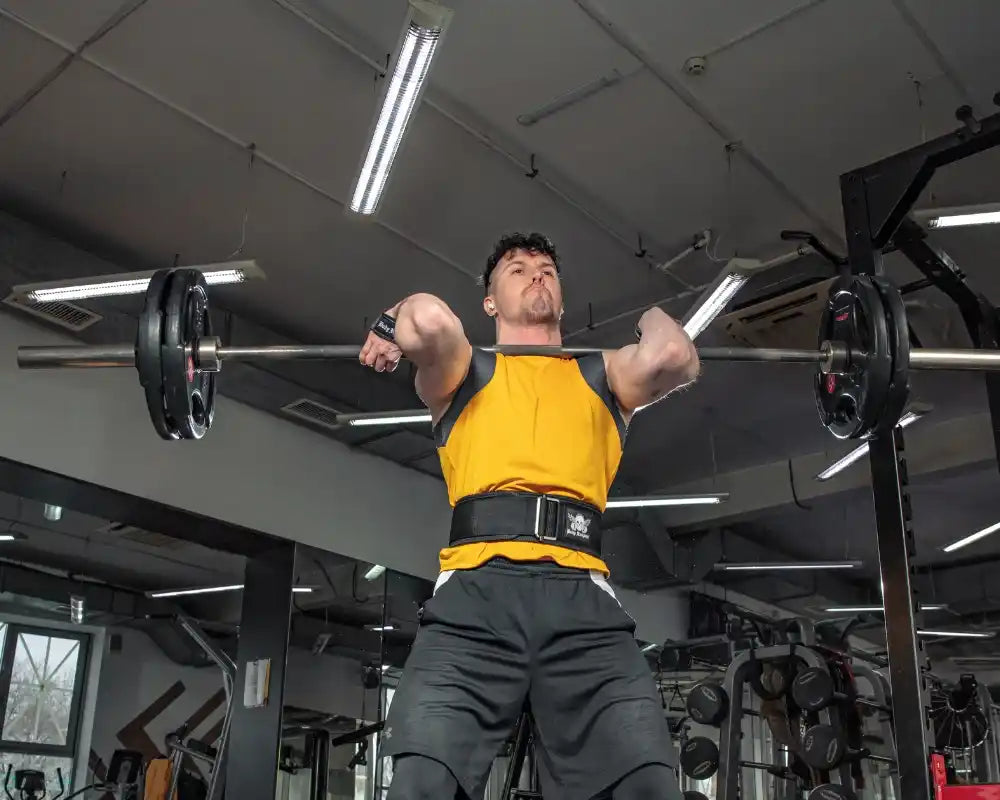
You have the form. We have the gear. Don't let your equipment hold back your gains. From lifting straps for a secure grip to belts for core stability, Body Reapers supports every perfect rep. Engineered for the Rep. Built for Results.
Recommended Gear



Leave a comment
This site is protected by hCaptcha and the hCaptcha Privacy Policy and Terms of Service apply.